Tuesday, February 09, 2010

A New Kind of Christianity


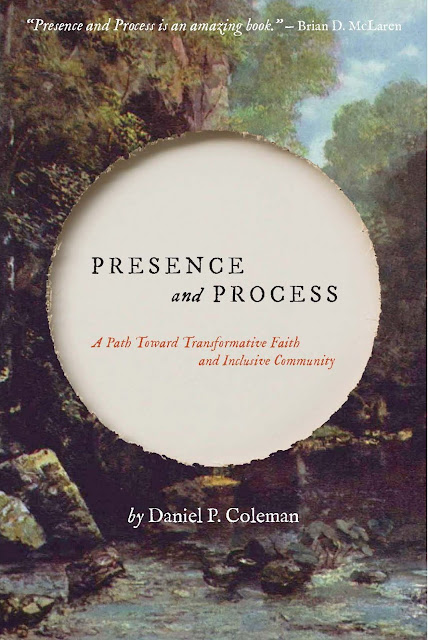
Brian McLaren's new book, A New Kind of Christianity, was released today. I'm already on chapter 7. It's really, really good.

Saturday, February 06, 2010

Theology Matters, Part 2: An example


Tmothy Travis wrote the following very thoughtful comment on my blog post entitled Theology Matters:
"'Bad' theology, as you put it, does allow people to rationally arrive at all kinds of terrible conclusions.

I am not clear yet, however, that the fact that one's theology includes the belief that God loves his creation and values every single person, will necessarily affect how one looks at the world and treats people.

I see so many people, and I am sure you do, too, whose theology includes these beliefs but whose lives are not a testimony to them, in whose lives these beliefs are not manifest."

I wanted to respond to Tmothy's comment, but realized it would probably be better to devote a new post to doing so. I'd like to give an example of how the belief that God loves his creation and values every single person affects how one looks at the world and treats people.

Several aspects of theology came to mind, such as Eschatology ("If Jesus is going to return soon and burn up the earth, why worry about global warming?"); or Atonement via Penal Substitution (aka "Jesus takes the punishment from an angry God on our behalf"); or Israel ("Does God prefer one ethnic group over others?"); or how God judges sin ("God sent the earthquake to Haiti and killed 100,000 people--including Christians--because their ancestors made a deal with Satan."); or Original Sin ("Sorry, the moment you were born you were guilty and condemned."), etc. All of these doctrines lead to a negative view of mankind. It could conversely be assumed that eschewing these doctrines might improve one's outlook about the world and mankind.

I decided instead for this post to focus on the doctrine of Hell.

I spent several years studying Hell: What the Bible taught about it; what early Christian theologians taught about it; what the Church throughout history has taught about it; what other religions that preceded or were contemporaneous to Judaism and Christianity taught about it; etc.

What I learned was that within Christianity there have been three general views about Hell. Each of these three views has been subscribed to by devout and learned Christians throughout the last 2,000 years.

The one we're most familiar with is sometimes called "Eternal Torment" or "Eternal Punishment". This is the teaching that Hell is a place of eternal conscious torment. Those souls who are rejected by God (either due to Predestination or failure to receive Christ as Savior) will spend eternity seperated from God in great anguish and agony (whether physical or merely existential is debated by adherents) with no possibility of rescue or relief.

Another view is sometimes referred to as "Conditional Immortality." This view is actually closest to what was the prevailing belief among Jews at the time of Jesus. Most of the Old Testament has no concept of Hell and, in fact, little detail about any form of afterlife. The Hebrew word "Sheol" simply means "the grave." Around the time of the Babylonian exile a belief began to gradually develop that at some point in the future God would reconstitute and resurrect righteous individuals from the grave (see Ezekiel's valley of dry bones in chapter 37). These fortunate resurrected ones would continue to live on the earth. By the time of Jesus, this was a commonly held belief (although the Sadducees didn't accept it). You will notice that much of the talk in the New Testament is not so much about "Heaven" as it is about "ressurection." Many historians and archaeologists believe that the unusual Jewish practice of "second burial" which was in vogue at the time of Jesus (in which the family of the deceased would disinter the body a year after burial --after the flesh had rotted away--and place the bones into an ossuary) was directly related to the belief in bodily resurrection.

A variation of "Conditional Immortality", called "Annihilationism" is held by Seventh Day Adventists and Jehovah's Witnesses, among others. This view teaches that all will be conscious after death and will stand before God's judgement, but those who are rejected by God will cease to exist rather than be sent to Hell.

The third general view about Hell which has been held by Christians is sometimes called "Universal Reconciliation" or "Christian Universalism" or "Trinitarian Universalism" (not to be confused with "Unitarian Universalism"). This position teaches that Jesus' atoning death and resurrection were efficacious for all people. Several of the early Church Fathers, including the most distinguished early Christian theologian, Origen (185–254), believed in Universal Reconciliation (often coupled with the belief in a limited period of afterlife punishment prior to acceptance into Heaven). According to this view, Hell, if it exists at all, is a period of correction and refinement for the purpose of redemption, reconciliation and restoration. A couple of hundred years after Origen, Augustine (himself a staunch supporter of the Eternal Torment view) wrote, "There are very many in our day, who though not denying the Holy Scriptures, do not believe in endless torments."

Surprisingly, I find that the strongest New Testament scriptural support is for the Univeral Reconciliation view, followed by the Conditional Immortality view. The view that I find least supportable by scripture, but most supported by Church tradition, is Eternal Torment.

Each of these views carries ramifications. If, like Augustine, I believe that man's default destination is a Hell of eternal conscious torment (due, at the very least, to Original Sin--another highly debatable doctrine which carries profound ramifications), then that is certainly going to color how I perceive the value of people in God's eyes. What does it say about people if God's default position towards mankind is wrath and punishment (a punishment which is endless and serves no constructive or redeeming purpose)? Additionally, saving people from Hell becomes of paramount importance. Earthly concerns of social justice become insignificant in light of the awful possibility of irrevocable eternal suffering. For example, John MacArther has stated, "The only reason Jesus came was to save people from Hell....Jesus had no social agenda....[He didn't come to eliminate poverty or slavery or]...fix something in somebody's life for the little moment they live on this earth." (reference courtesy of Brian McLaren--http://www.youtube.com/watch?v=OH1yOmij7Q4).

If, on the other hand, I believe that Jesus died to save all mankind and that He was successful in that endeavor, I suddenly see every person as a redeemed fellow citizen of Heaven and an object of God's unfailing love (even though they may not know it yet). God's default position towards them is love, reconciliation and restoration. If that's the case, I am apt to be much more concerned about seeking their welfare during this life.

It has been said that we become like that which we worship. If the God I worship is one who has written off most of humanity and (perhaps regretfully) consigned them to eternal isolation and torture, how will that influence the way I see people? If, on the other hand, the God I worship intimately cherishes every individual and has, in Christ, successfully saved each person from the ultimate effects of their sin, will that not cause me to have "soft eyes" towards them?

Christian theologian and philosopher Thomas Talbott set forth an enlightening treatise, sometimes referred to as "Talbott's Triad." I present it here in simplified form:

I'm going to state three theological propositions. Most Christians, if they were presented with each of these propositions individually, would agree with each one. However, when the three are presented together, a contradiction becomes apparent. Here they are:

Proposition #1: God, being omnipotent, is able to accomplish His will.
Proposition #2: God's will is that none should perish, but that all would be saved.
Proposition #3: Many will not be saved.

Do you see the contradiction? How one deals with this tends to define what theological "camp" one ends up in.

If you accept #1 and #3, you must logically reject #2. This would make you a Calvinist (named after John Calvin, although it was really Augustine who established this doctrine): God has sovereignly decreed that only certain "elect" individuals are predestined to be saved (which, by implication, means that He has also predetermined that the remainder will not be saved). Those who were not predestined for salvation will either go to a Hell of eternal conscious torment or will be annihilated, depending on which doctrine of Hell you subscribe to.

If you accept #2 and #3, you must logically reject #1. This is the Arminian position: God would like to save everyone, and sent Jesus to do so, but His will in the matter is trumped by man's free will. God can only offer the opportunity for salvation; man must decide whether or not to accept it. If they reject it, (despite God's will) they will go to Hell or be annihilated (again, depending on one's view of Hell). Calvinists argue that Arminianism denigrates the sovereignty of God. God's intentions are thwarted.

If you accept #1 and #2, you must logically reject #3. This is the view of adherents to Universal Reconciliation. This view preserves the sovereignty of God. God has accomplished what He intended to do. Arminians would argue that it denigrates man's free will.

Because of my own experiences and studies, I've come to believe in the third position. I believe in Universal Reconciliation. I still remember the moment that the acceptance of this view crystalized in my heart. I literally cried out aloud, "This changes everything!" It has. It radically changed how I look at the world and other people. I no longer think in terms of "us and them" or worry about who is "in" and who is "out". I see God actively working in everyone's life with the ultimate goal of their redemption. Some, due to circumstances or free will choices, will have a more difficult journey, but the ultimate destination is the same for all of us: Home. I find myself overcome with awe and gratitude to a God and Christ who has completely overcome sin and death with love and life. He has accomplished His will. He has succeeded! He is victorious! I am inexorably drawn into worship of a God like that! I am also much more concerned with social justice issues. Also, perhaps counter-intuitively, I am much more interested in evangelism: I want people to know about the wonderful opportunity they have to walk with God and experience His love here and now as well as throughout eternity.

Abraham Lincoln once said that the best way to destroy an enemy is to make him a friend. I believe that God will destroy His enemies, not through violence but through love. I believe that, as scripture says, "every knee will bow, in heaven and on earth and under the earth, and every tongue will confess that Jesus Christ is Lord, to the glory of God the Father" (Phil. 2:10-11) and that this bowing and confessing will not be the involuntary forced tribute of conquered enemies but rather the wholehearted freewill praise of a gratefully reconciled humanity. The former would be a phony glory; the latter would be true glory.

As Quakers like to say, I believe that there is "that of God" in everyone and therefore that I should treat everyone with honor and respect and consider that perhaps they have something to teach me as a result of the way that God is working in their lives to reveal Himself as He draws us all closer to Him.

Sunday, January 31, 2010

The Elders

Most of the churches I've attended, in the 25+ years that I've been a Christian, have been "baby boomer" churches. The congregations were comprised mostly of younger people with only a smattering of older folks. By contrast, the church I now belong to has a large number of senior citizens. This has been a revelation to me. I facilitate a Sunday School Bible class in which, at age 47, I am the youngest person there. Many of the attendees are in their 70's and 80's. One of the most loyal and active participants is a gentleman who recently turned 100. I am constantly humbled, amazed and edified by the wisdom and gentle patience of these elders. There is a term that Quakers use to refer to someone who is older, wise and respected; they are called a "weighty Friend."

Our culture tends to idolize youth. Many churches seem to skew that way also. An emphasis gets placed on young, dynamic leaders. Often (at least in my experience) these young leaders have zeal but lack patience, wisdom and gentleness. I've known a few young (and not so young) pastors and elders who did not measure up to the criteria for elders that Paul laid out in his letters to Timothy and Titus. They were impatient, intemperate, pugnacious, unlearned and lacking in self-control. They were elders in name only. I've seen many "sheep" get damaged as a result. I've also known a few "real" pastors and elders.

It has been said that wisdom is perishable. Unlike information or knowledge, it cannot be stored in a computer or recorded in a book. It expires with each passing generation. Elders who are truly elders--older, wise, patient, gentle, humble and learned--are priceless treasures. Sadly, they are often buried treasures--overlooked and passed by. I've learned to eschew the "young and trendy" in favor of the "old and steady" and to seek out the wisdom of these elders.

Saturday, January 23, 2010

Quote of the Day:

"When they ask me at the Post Office if my package contains anything dangerous, I never know quite how to answer. It contains books, and if a book isn't dangerous, then why was it written?" - Karen L. Oberst

Monday, January 18, 2010

MLK


"The arc of the moral universe is long, but it bends towards justice." - Dr. Martin Luther King, Jr.

Sunday, January 17, 2010

Theology matters.

Everyone has theology.

Theology, in its most basic form, is simply how we think about God. Our perception of God has a dramatic effect on how we perceive ourselves and on our view of mankind in general. As a result, our theology affects how we live our lives and how we treat other people. Even atheists have a theology. Their's is just very short. It drives me crazy when Christians pooh-pooh theology. "We don't need theology," they say, "we just obey God." What nonsense. The very fact that they used the word "God" implies that they have a fairly developed theology. When asked (and sometimes when not asked) these same folks will tell us in great detail about their God and about their God's orientation towards mankind and about their own relationship with their God. In other words, they will describe their theology.

Everyone has theology. The real issue is whether or not they have given their theology much thought. This brings us to the more refined sense of the word "theology": the study of God. Theology in this sense implies a certain degree of intentionality and intellectual rigor, which may scale anywhere from simply reading a C.S. Lewis book (or, God forbid, "Left Behind) to devoting one's entire life to in-depth theological academic pursuit. Of course, in any endeavor one can get lost in the details and lose sight of the big picture. One thinks of the theologians in Umberto Eco's "The Name of the Rose" who hold a convocation to discuss the matter of whether or not Christ owned the tunic that He wore (and end up in a fractious debate about it).

Conversely, there is the story of the great Swiss-German theologian Karl Barth who, towards the end of his life gave a lecture at the University of Chicago Divinity School. At the end of the lecture, Barth was asked by the president of the seminary the following question: “Of all the theological insights you have ever had, which do you consider to be the greatest of them all?” After a moments thought, Barth replied "Jesus loves me, this I know, for the Bible tells me so.” He hadn't lost sight of the big picture.

Still, theology matters. Let me give you an examply of why. Let's say part of my theology is the belief that Hell is a place of eternal conscious torment. Further, let's say that my theology maintains that all people are, by default, bound for Hell unless they subscribe to a particular set of doctrines. Someone who teaches contrary to this particular set of doctrines is, therefore, responsible for causing people to go to Hell and be tormented for eternity. It suddenly becomes fairly easy to justify imprisoning, torturing and executing teachers who "mislead" people by propigating "false doctrines". After all, isn't it better to burn a few heretics than to allow them to lead multitudes into the fires of Hell? Likewise, if we force people--under threat of violence--to accept our doctrines and, therefore, avoid Hell, they'll eventually thank us for it. Right?

History is filled with examples like this. They are the tangible and tragic results of bad theology.

On the other hand, if my theology includes the belief that God loves His creation and values every single person, will that not also profoundly affect how I look at the world and treat people?

Theology matters.

Socrates, when he was put on trial for heresy by the Athenians, famously said, “The unexamined life is not worth living.” Along similar lines, I would say, an unexamined theology is not worth having; and it may actually do more harm than good.

Saturday, January 16, 2010

My Bad Eye


My son once told me that I sometimes look like a pissed off Siamese cat. Upon hearing this, my wife concurred. There's nothing like loved ones to tell it like it is. There is a reason for their assessment of my appearance: When I was a child I had a pretty severe lazy eye--to the point that I was made to wear a patch over my "good" eye in order to get the other one to straighten out. I have very good vision in one eye and very poor vision in the other. The net result, so I'm told, is that I sometimes look like a pissed off Siamese cat. This also, I think, tends to give people the false impression that I'm angry at them or looking at them in a critical way. In actuality, it's just that my eyes are slightly screwed up. Really.